by KLEOS
Radio Access Network (RAN)
- Designed, manufactured, and deployed by KLEOS
- Full hardware and software control
- Ultra-low total cost of ownership
- Clear roadmap from 5G to future 6G standards
 5G · AI-driven · End-to-End Digital Services
Technology architecture
Real value comes from platforms, services, and intelligence built on top.
The Value Chain
Full-Stack Control
We control our technology stack through industrial-grade partnerships and cloud-native architectures, ensuring speed, resilience, and long-term scalability.
by KLEOS
Partner-enabled cloud core
Digital content ecosystem
SIG Holding
Cloud-core and international-network services are supplied and operated by external partners under project-specific agreements.
Technology architecture
As an official KLEOS distributor, SK Technology presents a radio-access proposition distinguished by extended coverage, high capacity and compelling network economics. Selected international partners complete the architecture with cloud core, connectivity, roaming and digital-service capabilities.
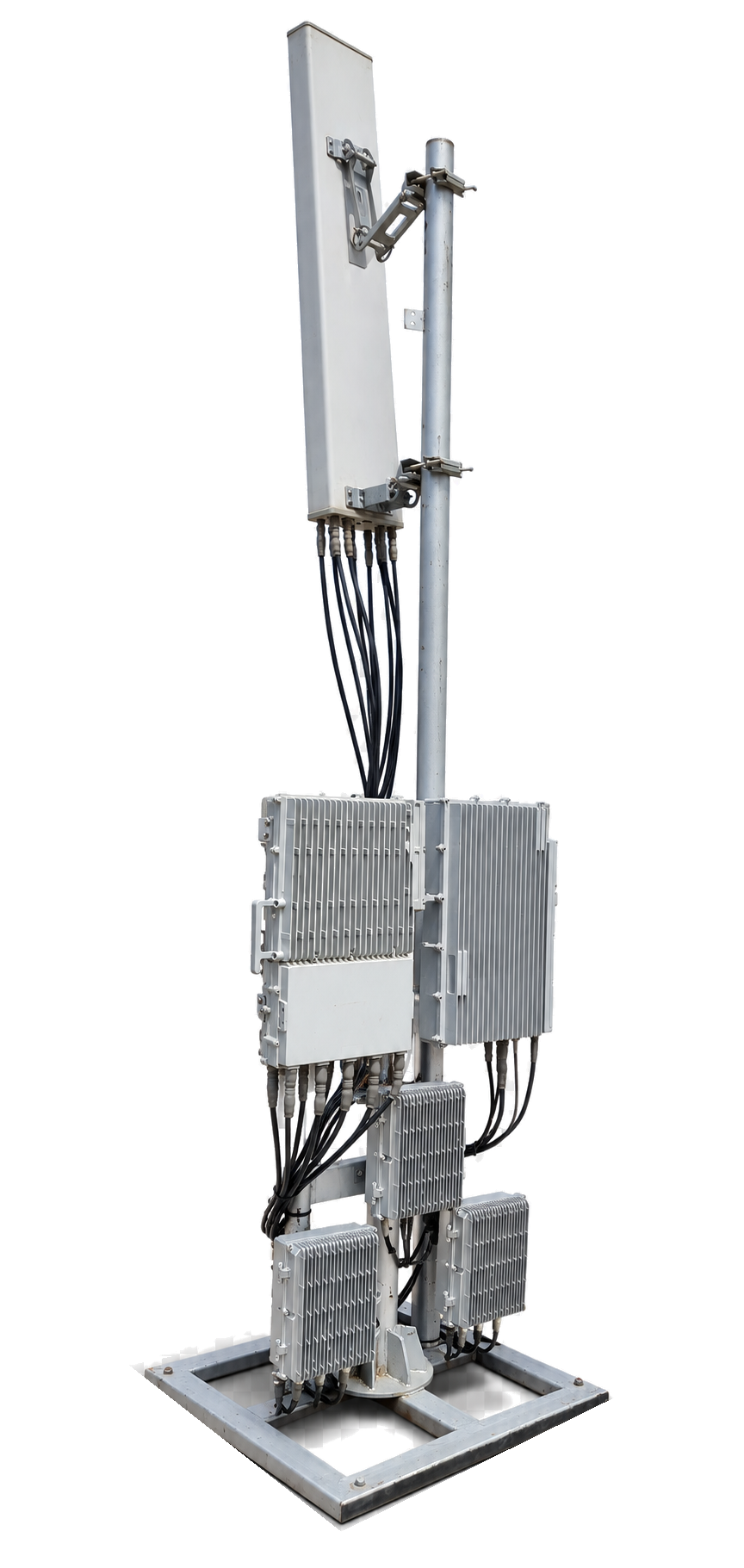 01
01Radio access
High-performance macro radio infrastructure delivering an average of 1.3 Gbps in 4×4 MIMO (4T4R) and capable of reaching an average of 2.6–3.0 Gbps in 8×8 MIMO (8T8R), subject to configuration and deployment conditions.
Official source · KLEOS ↗ 02
02End-to-end operator model
A modular framework bringing together radio access, core network, transport, OSS/BSS, security, service enablement and operational support around each market’s requirements.
 03
03Digital content
Content and applications designed for integration into mobile offers, helping operators differentiate bundles and create new digital-service opportunities.
 04
04AI-enabled services
Mobile-first education, training and AI-assisted management tools for individuals, schools, SMEs and enterprise customers.
A decisive technological advantage
KLEOS radio performance, a 5G ICS Smart Relay layer and an external global operator’s cloud-native virtual core are combined into one operator-ready proposition: wider coverage, intelligent network management, international reach and faster digital-service activation.
Average radio throughput in the appropriate configuration and spectrum conditions.
Average throughput achievable in advanced-capacity configurations.
A rapid, near plug-and-play technical path once agreements and prerequisites are complete.
Potential reach through the international roaming ecosystem of the external network partner.
The partner-delivered Core Network as a Service combines a directly accessible cloud-native virtual core with advanced network-management tools. It can accelerate the activation of applications, content, streaming, e-gaming, leading social platforms and AI-powered management services for SMEs, subject to the definitive agreements for each project.
* Average radio figures vary with spectrum, bandwidth, MIMO configuration, software, devices and deployment conditions. The approximately 30% comparison is an indicative deployed-cost ratio, installation included, between an ICS Smart Relay and a NodeB in suitable, validated radio topologies. NodeB-equivalent throughput and coverage depend on donor-signal quality, spectrum, topology and operator acceptance; ICS Smart Relays consume materially less electrical power. Cloud core, roaming, applications, content, streaming and platform integrations are supplied or operated by an external partner. The two-week target begins after contracting and completion of the applicable regulatory, commercial and technical prerequisites.
Network intelligence
Compute, radio, transport, edge and cloud are coordinated to deliver the performance and resilience expected from next-generation mobile services.
 01
01AI infrastructure
Compute, edge resources and secure data flows bring intelligence closer to users and operations.
02End-to-end coordination
A unified architecture connects coverage, capacity, service platforms and operational control.
 03
03Network performance
Performance engineered for immediate experiences, critical applications and service continuity.
Coverage economics · ICS Smart Relays
ICS Smart Relays intelligently reuse the donor network by identifying and cancelling feedback interference in real time. Introduced by Serge Khalifé from 2010 with operators in North Africa and the Middle East, they enabled wider coverage and materially lower deployment costs in demanding radio environments.
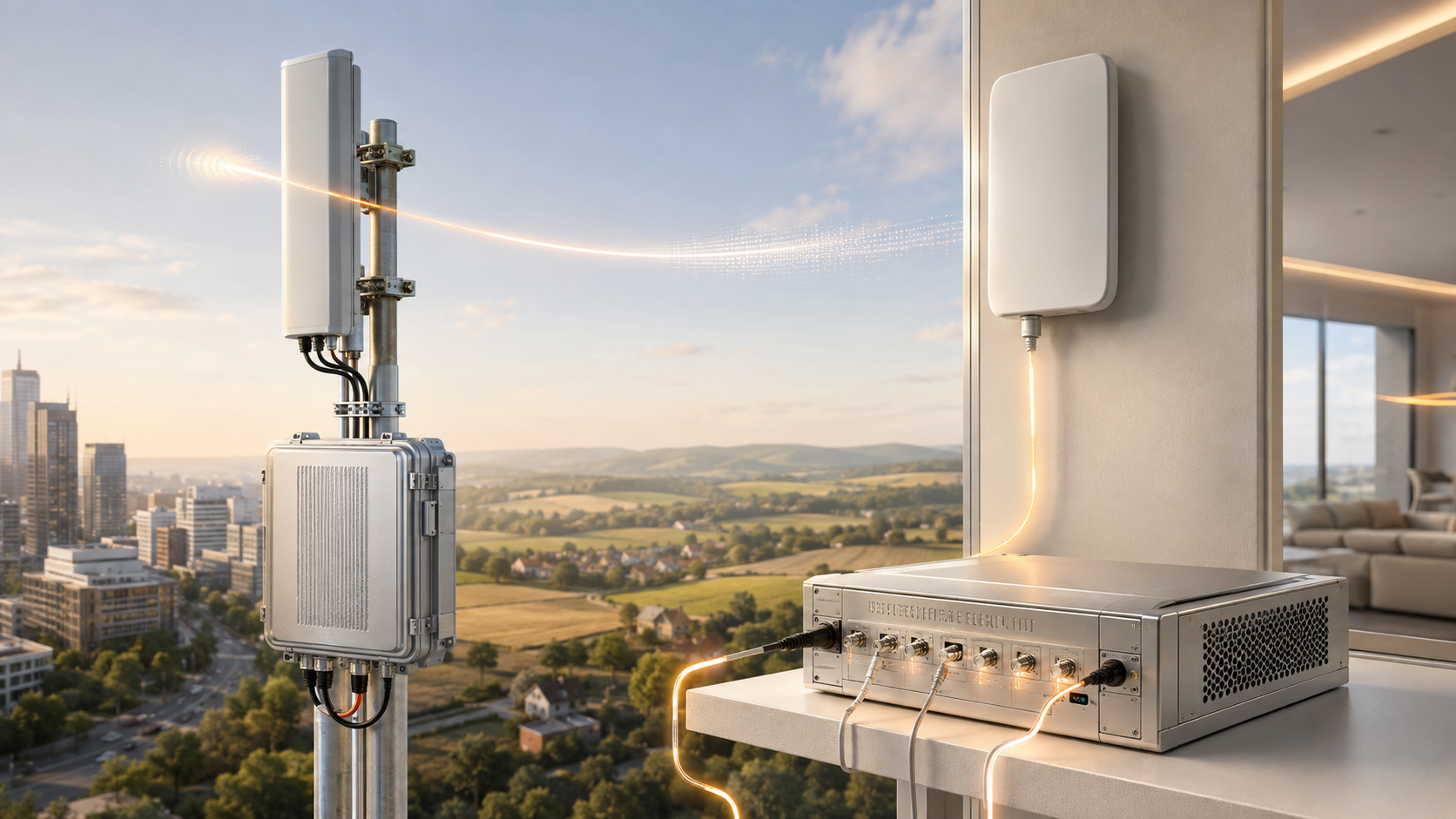
How interference cancellation works
The donor antenna receives the serving cell’s 5G signal while the service antenna retransmits it towards the target area. Installed back-to-back and operating simultaneously, the two antennas inevitably create a feedback path. The ICS algorithm continuously estimates that coupling, generates an inverse cancellation signal, suppresses the echo before oscillation and then applies controlled gain to the clean signal.
Captures the useful 5G signal from the serving macro cell.
Measures the leakage returning from the service antenna into the donor path.
Models the feedback channel and injects an inverse signal to cancel interference in real time.
Rebroadcasts the amplified, stabilised signal towards the new coverage area.
Introduced across North Africa and the Middle East
Same throughput and coverage in a suitable, validated topology
Indicative deployment cost versus a NodeB, installation included*
Coverage for basements, parking areas and other shadow zones
In a suitable, validated radio design, outdoor ICS units can deliver NodeB-equivalent throughput and coverage for around 30% of the NodeB deployment cost, installation included, while consuming materially less electrical power.
Compact multi-band units bring the donor signal into hidden areas such as basements, underground parking, corridors and dense indoor environments.
Power-conscious design, remote operation and immediate visibility of system status support a lighter operating model.
A disciplined network equation
Target shadow zones with a focused relay layer and reserve complete macro sites for the locations that truly require them.
Reduce the potential footprint of civil works, energy, backhaul and field intervention through efficient equipment and remote supervision.
Bring serviceable coverage to market sooner and align network expenditure more closely with the revenue potential of each territory.
SK Technology · Field engineering
ICS Smart Relays introduced with operators across North Africa and the Middle East for indoor and outdoor coverage extension.
Before-and-after KPIs, drive tests and operator acceptance protocols frame every technical validation.
Wireless broadband lineage
SK Technology’s experience includes early work to introduce WiMAX. iBurst is no longer an active platform: its technology evolved into KLEOS, whose current operator-grade 5G radio platform is compatible with the 3GPP Release 17 standards framework.
Hands-on experience with the first generation of metropolitan wireless broadband propositions and their deployment economics.
KLEOS combines advanced radio engineering, 8×8 MIMO and beamforming in an operator-grade platform built for wide coverage and high capacity.
The current KLEOS 5G platform is presented as fully compatible with the 3GPP Release 17 standards framework.
Terrestrial + non-terrestrial networks
Low-Earth-orbit satellite broadband can connect isolated territories quickly, provide resilient backup and supply backhaul where fibre is unavailable. Its role is valuable. It is nevertheless designed around a different network equation from a terrestrial 5G SA system engineered for concentrated capacity, spectrum reuse, local edge computing and controlled quality of service.
Starlink’s advertised residential maximum; actual performance varies by plan, location, congestion and installation.*
KLEOS 4×4 MIMO (4T4R), with validated peak performance up to 1.6 Gbps under suitable conditions.*
KLEOS 8×8 MIMO (8T8R) in advanced-capacity configurations and suitable conditions.*
Rapid availability, remote coverage, emergency resilience and backhaul for selected sites.
High-capacity cells, deterministic local paths, edge inference, industrial control and intensive machine-to-machine traffic.
Satellite connectivity supplied by external partners can feed selected locations while KLEOS RAN, ICS Smart Relays, edge and the partner-delivered cloud core manage the local mobile experience.
EDGE · AI · M2M
AI inference, digital twins, connected industry, high-definition streaming and autonomous machine dialogue increasingly require large symmetrical data flows, high availability and very low response times. Dense terrestrial radio and edge computing place reusable capacity close to users and machines; satellite adds reach and resilience to the overall design.
* Performance figures are not like-for-like service guarantees. Starlink figures are published service claims; KLEOS figures are radio-performance values supplied for specified configurations. All results depend on spectrum, bandwidth, equipment, topology, congestion, devices, weather and deployment conditions. Satellite and international-network services are supplied and operated by external partners under project-specific agreements.
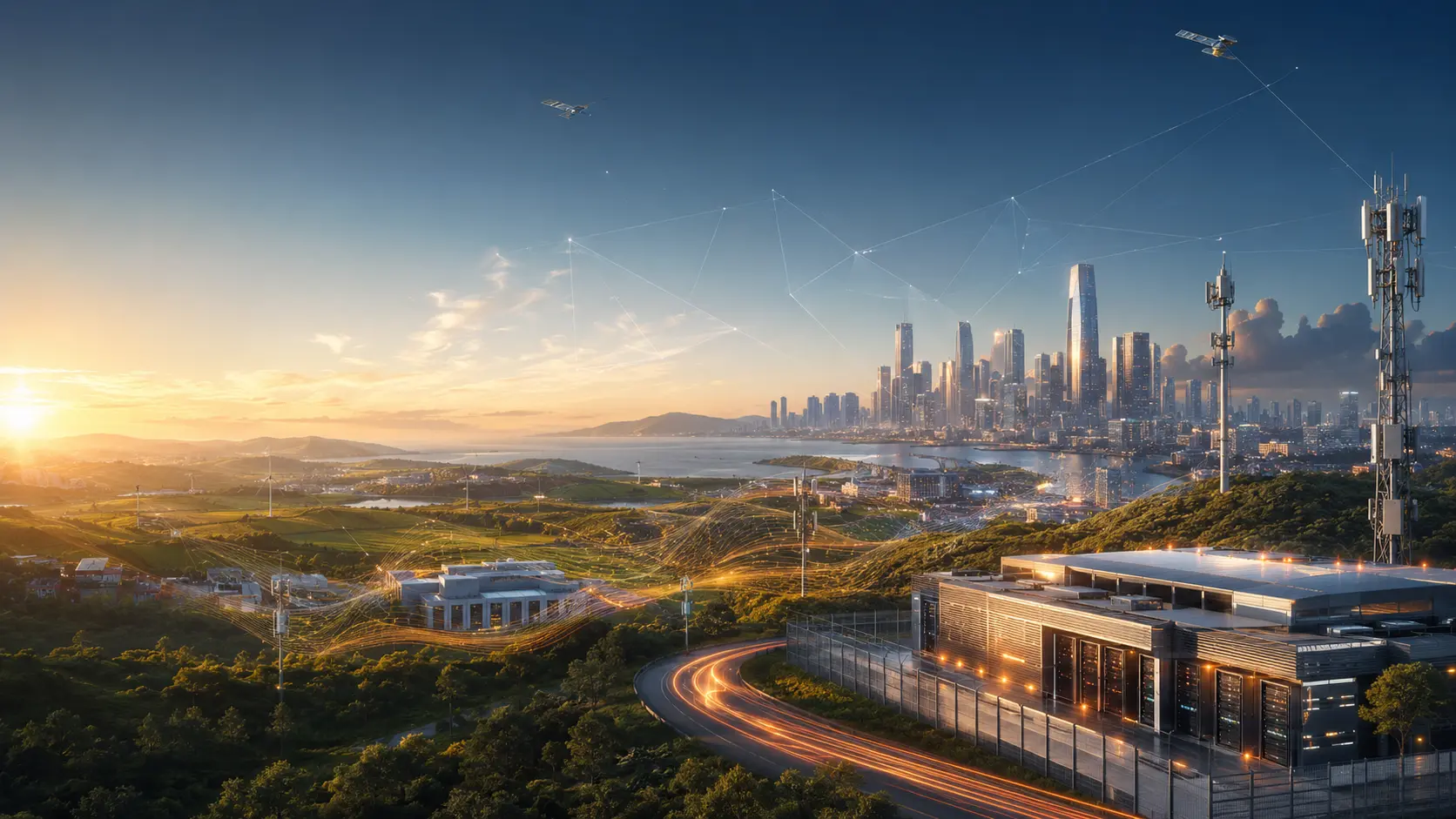
Radio access reference
Official KLEOS distributor
SK Technology officially distributes KLEOS and introduces its radio-access solutions to leading international operator groups serving several hundred million subscribers worldwide. KLEOS infrastructure can be associated with brand-neutral core, transport, operational systems and AI-enabled digital services in a modular end-to-end proposition. Core, transport and international-network services are supplied by external partners through partnerships that enable SK Technology to propose those services. Each operator opportunity remains subject to technical validation, definitive agreements and regulatory authorisations; an introduction never implies an operator product decision.
Macro radio infrastructure engineered for coverage, capacity and deployment flexibility.
A partner-flexible architecture for core network, transport, OSS/BSS, security and support.
Applications, e-gaming, education and enterprise tools designed for operator integration.